Total Pageviews

Thursday, January 23, 2014

Boutique razors - the manly thing to do

What is up with the boutique razor craze sweeping the nation? Okay, maybe craze is too strong a term. But it sure seems like these trendy, affordable facial deforesters are popping up everywhere. Not that that's a bad thing. I looked at Gillette razor prices the other day and almost fainted, right there on aisle seven.

The first exposure I had to this hedonistic shaving-man plan was the Dollar Shave Club (DSC). I have to admit experiencing a certain guilty pleasure when watching their goofy television commercial.


Actually, I had planned to embed DSC's commercial in this blog but couldn't find a version that did not include their snappy tag line (which I never noticed on network television)...Our blades are "&%^$-ing" great.

Author's Note: I had a much looser version of the expletive in question (above) in the original blog post. Apparently it was enough to flag Blogger's own expletive filter. Let's see if my shift-key version flies...X

The DSC has, from everything I can tell, a tremendous product. If you're good with an old-school 2-blade razor (like me), they will send you a free handle and five blades to get you started, with an additional five blades every month thereafter for a measly $1 per month. That's insane. Even with the shipping + handling charges added on, this pricing blows even nasty, disposable razors out of the water.

DSC also has more upscale razors with four or even six blades. I'm sorry. Who in the world needs six blades on their razor?

I'm guessing DSC are selling a boatload of these to people that don't mind a little expletive with their product marketing. (The latest customer count I found for DSC was 300,000 monthly subscribers)

I happened to check my Twitter feed today at lunch. And there at the top was an over-sized tweet advertising Harry's razors. Browsing Harry's website, I was grateful for the apparent lack of expletives. In fact, Harry's seems to be aiming for a much more metropolitan clientele. I'm guessing Harry's customers don't lean back and undo their top button after a good meal.

The Harry's site news feed notes that their razor blades are going to get even better...because they bought the factory in Germany that makes them. Top that, Michael Dubin.


Andy Katz-Mayfield & Jeff Raider (Harry's founders)

German engineering aside, Harry's is not going to compete with DSC...unless it's on image. If I go with Harry's, I'm going to pay for the handle - $10 for something called "The Truman" or $20 for the clearly superior "Winston".

And we haven't even gotten to the blades yet.

Harry's blades are still a good value - $2 per blade if you buy the 4-pack (individual blade cost decreases if you purchase a larger package; 8-, 12-, and 16-packs are available). But still...they're not beating a <inferred expletive deleted> dollar per month.

Money no object? You can shop at places like Classic Shaving. Be prepared to fork over some cash for that classic shaving cream and horsehair brush, though. Cartridge razors? Look out for those north of $50 prices - and that's just for the handle.

So what's a guy to do?

We could all just say, "Forget it!" and grow beards. But I'm guessing there would be a lot of upset significant others. Or we could blithely ignore the edgy marketing campaign at DSC and go with, hands-down, the best shaving deal on the planet.


We're gentlemen; be gentle...

And lest you think DSC is all about shaving...

What do you think?

X

Friday, January 3, 2014

Is self-esteem our greatest sin?

This is going to be a painful discourse. The first thing for which I will be excoriated is suggesting that self-esteem is sin - a term that atheists and even some religious folk will discount immediately as irrelevant and perhaps even offensive. Before we commence, let's try to agree on the definition of self-esteem.

Looking at definitions of self-esteem in several dictionaries, I sense a pattern:

Dictionary.com:
1. a realistic respect for or favorable impression of oneself; self-respect.
2. an inordinately or exaggeratedly favorable impression of oneself.

World English Dictionary:
1. respect for or a favourable opinion of oneself
2. an unduly high opinion of oneself; vanity

Merriam-Webster Dictionary:
1. a confidence and satisfaction in oneself : self-respect
2. self-conceit

The first definition in all these references has to do with, what I believe, is most people's idea of self-esteem. In their Psych Basics section, Psychology Today defines (and I use that term loosely here) self-esteem as:

Possessing little self-regard can lead people to become depressed, to fall short of their potential, or to tolerate abusive situations and relationships. Too much self-love, on the other hand, results in an off-putting sense of entitlement and an inability to learn from failures. (It can also be a sign of clinical narcissism.) Perhaps no other self-help topic has spawned so much advice and so many (often conflicting) theories.

PT then goes on to offer a list of more than 25 articles readers can view covering a variety of self-esteem basics which, they say, are our best insights on how to strike a balance between accurate self-knowledge and respect for who you are.

Reviewing the definitions above and the psychological implications, it's pretty clear that self-esteem is one of those things that needs to be finely balanced in our lives. These days though, we live in a Goldilocks world. I'm sure we can all recall the fairy tale from our childhoods when the girl finds the house in the woods and samples three items: porridge, chairs and beds. Leaving aside the obvious issue with this young lady feeling so bold as to enter a stranger's house in the middle of the forest, she is quite picky with regard to her comfort.
Maslow's Hierarchy of Needs

I've written about Abraham Maslow's Hierarchy before so I won't go into detail again. If you want to read up on his theories you can do so here. If we overlay the story of Goldilocks and the Three Bears on top of Maslow's Hierarchy, we can see that Goldilocks lives in the bottom layer of his pyramid. In the fairy tale, she is completely focused on physiological needs with, just maybe, a touch of security of body (safety) thrown in. If Goldilocks had high self-esteem, she would have handled the situation differently considering where respect of (and by) others sits in the pyramid of needs.

Back to reality, how can I float the suggestion that somehow self-esteem is connected with doing bad things? Well, since I used the term sin in my blog title, I'll come at this from a Jesus perspective. In the Gospel of Matthew 20:26-28, Jesus is quoted as saying, "It is not this way among you, but whoever wishes to become great among you shall be your servant, and whoever wishes to be first among you shall be your slave; just as the Son of Man did not come to be served, but to serve, and to give His life a ransom for many."

So, does this mean that Jesus had no self-esteem?

The Gospels are full of examples where Jesus did not rise to the challenges which most of us would attack from a self-esteeming position.

Early temptations: immediately before his earthly ministry really gets rolling, Jesus is attacked in the desert and tempted by Satan who targets every attack right at the heart of self-esteem. Is Jesus hungry? If he's the Son of God, just change these stones to bread. Feeling minimized? Worship Satan and gain all the kingdoms of the earth. Are you really immortal? Cast yourself down and watch the angels catch you before you hit the ground.

Every single one of these temptations sought to encourage Jesus to respond in a selfish way. Fortunately for us, that's not what He was here for.

Time after time, Jesus was offered the chance to elevate Himself. Matthew 22 has example after example of Pharisees, lawyers and scribes trying to trip Jesus up, get him to play the big man on campus so they can arrest him for blasphemy.

Both the Chief Priest and Pontius Pilate ask Jesus if He is the Christ or King of the Jews. Jesus responds in kind to both, letting Pilate know in Matthew 27 that it is others who are giving him the lofty titles, not himself.

Finally, in one last, cruel gesture, Luke 23:39 recounts one of the criminals who were hanged there was hurling abuse at Him, saying, “Are You not the Christ? Save Yourself and us!”

If Jesus were living according to Maslow's Hierarchy of Needs, history would have been very different indeed. Despite His selfless examples, humanity has still progressed to the point where we have elevated self above all else. Looking at Maslow's pyramid, there is no sin in Esteem. Confidence, achievement, respect of others - respect by others - all of these things are good. If each of us has managed to climb above the lower steps of the hierarchy, to satisfy our basic physical and psychological needs, then a little self-esteem helps us love others as we love ourselves. That sounds a lot like what Jesus told the lawyers in Matthew 22:39.

Self-actualization gone wrong...

One of the problems with Maslow's Hierarchy - in my opinion - is that the higher up we go, the less likely we will be to adopt a servant mentality. In today's world, if you are a servant, that means you're being oppressed. If my goal in life is to reach the top of the pyramid, what am I striving for? Maslow says I can find morality at the top of the hierarchy. What does that mean? Do I have no morality until I get there? If that's the case, then self-esteem could be a sin because it sits a level below morality. If I have no morality but I have self-esteem, what am I?

So what's my point?

Self-esteem is fine as long as it is balanced against the needs of society as a whole. There are a mountain of books that offer to help us overcome esteem-busting people in our lives. You know the ones. But if we put all our effort, all our being, into reaching the Holy Grail of self-esteem; if self-esteem becomes the be-all and end-all, then we lose sight of the big picture...the greater good.

Perhaps my biggest point is that if we focus too much on self, we will miss the real source of our esteem.

What do you think?

X

Tuesday, December 31, 2013

You're already dead...

...you just don't know it yet.

I know, you were expecting some thoughtful end-of-the-year blog celebrating all that was good about 2013 and looking forward to the promise of 2014. Sorry to disappoint you; I discovered this morning that I'll be dead someday so I'm feeling a little down about this whole life thing.

According to The Death Clock website I'll be cashing in my chips on July 7, 2032. So in less than nineteen years I'll bid you all a final adieu...unless one or more of a variety of totally unknown things should occur in the meantime.

I guess I just need to watch out for falling pianos...

I didn't wake up this morning pondering my own demise. Everything was going along pretty much like normal. I was in my car, driving to the office and listening to NPR and this segment came on about a new product available in April 2014 called Tikker, The Happiness Watch. According to the Tikker website, "We’re building a watch that counts down your life, in order to make the world a better place!"

What?

Tikker comes in snappy, happy white and, um, black...

Fredrik Colting, Tikker's inventor, is a 37-year-old former gravedigger from Sweden. Let the irony of that sink in for just a minute...

The thought behind Tikker is to remind us to savor life while we still can. In fact, the NPR piece noted studies from 2009 and 2011 that found thinking about death makes people more generous and more likely to donate blood. Not to go all Fox News on you but, in all fairness, Lulu Miller also interviewed Sheldon Solomon, one of the grandfathers of an idea in social psychology called Terror Management Theory.

Listening to Ms. Miller interview Mr. Solomon, I was not encouraged to run out and buy a Tikker. Psychology Today notes that: The terror referred to in terror management theory (TMT) is that which is brought on by the awareness of the inevitable death of the self. According to TMT, the anxiety caused by mortality is a major motivator behind many human behaviors and cognitions, including self-esteem, ethno/religio-centrism, and even love.

Dr. Solomon (Skidmore College) and his colleagues found in their studies that rather than making us more compassionate, knowledge of our own mortality tended to make us more xenophobic, among other things. One example cited during the NPR segment was how a group of Christians began to dislike Jews more when subjected to conditions which highlighted their own mortality. Solomon's research - in collaboration with fellow psychologists Jeff Greenberg (University of Arizona) and Tom Pyszczynski (University of Colorado) - showed that we defend our cultural worldviews more strongly when subjected to death reminders.


Alas poor Yorick...loser!

I'm still trying to get my head around the idea that if I was in the hospital for a risky surgery, according to TMT, I might be getting all bowed up about Jewish folks. In fact, as a Christian, I believe that the Jews were (and are and will be) a pivotal part of Jesus' mission on earth. While I can somewhat understand why some ancient Christians might have looked down on the Jews - after all, it was the Pharisees that begged Pilate for crucifixion - everything proceeded according to God's plan so why dog pile the Jews about it?

In the end (no pun intended), I do tend to side with Colting that my natural inclination if faced with my own mortality would be to get the most out of life in some altruistic way. Still, it's impossible to say just how I would react in those dire circumstances. It's easy for me to look at my own little Death Clock, with nineteen or so years to go, and be relaxed about it. Hopefully, as those numbers dwindle, I will be more apt to have a positive outlook and do my best to help others rather than morph into some sort of xenophobic serial killer.

With that in mind, I could rush out and order my own Tikker for the pre-release price of $59 (the regular price is $79 which illustrates the axiom time is money) but I think I'll pass. Psalm 139:16 says: Your eyes have seen my unformed substance; and in Your book were all written the days that were ordained for me, when as yet there was not one of them.

It wouldn't matter one bit if I bought a watch that uses some man-made algorithms to determine the date of my passing. God is already keeping an eye on that for me and I just need to treat each of the days I'm given as precious. I don't need any death reminders to do that.

What do you think?

X

Saturday, December 21, 2013

It's time to ask yourself...

...what you believe.

Dr. Jones in mortal danger (Indiana Jones and the Last Crusade [1989])

One of the fun things about the Indiana Jones film franchise is the exploration of possibilities. That fun got a little off track in The Crystal Skull [2008]. but I enjoyed the film anyway.

In The Last Crusade, Walter Donovan is on the verge of discovering the Holy Grail, with only Indy and his father standing in the way. Like any good movie villain, he resorts to some eye-popping violence to motivate another character. By shooting Indy's father, Donovan motivates the hero to take those last few steps and reveal the treasure.

It has been said that life imitates art. I'm not completely sure I buy that but I've seen some some examples which prove the axiom lately. A friend of mine posted a video this morning that I thought summed up a portion of this thoughtline in a powerful way. In The Last Crusade, Donovan pointedly says to Indy, "It's time to ask yourself what you believe."

What does that mean? It means that while Indy's father was bleeding out on the floor of the cave, the only thing that could possibly save his life was the Holy Grail - something Indy wasn't even sure he believed in. For to believe in the Holy Grail was to believe in Jesus Christ and God and Creation and everything. Indy understands all of this a few minutes later as he stands on the precipice of what seems to be an insurmountable chasm between him and the Grail.

"It's a leap of faith..."

This video is about 38 minutes long. I am not posting it here to change your life. My hope is that folks who stop by will take the time to watch it and just think about what it means. There are some PhD's in this video - very smart people - and there are some students in this video, and there are some regular folks on the street in this video. Enjoy.


X

Friday, December 6, 2013

Literary Review - Reckonings by Gail Husch

Someone Wicked, a Written Remains anthology, was released by Smart Rhino Publications on November 25, 2013. Edited by Weldon Burge and JM Reinbold, Someone Wicked contains twenty-one tales of wickedness sure to please the most discerning reader.

Over the next few weeks, my plan is to read and review many, if not all, of the stories contained in Someone Wicked. I have not historically been a big anthology reader but having had the opportunity to get to know many of the authors through the Written Remains Writers Guild, I am excited at the prospect of discovering each  of their unique and individual writing styles.


Have you ever had the urge to get back at someone? We've all been cut off in traffic, had to wait behind that clown with a full buggy in front of us in the grocer's express line, or watched out of a window while the neighbor's dog used our front yard as its personal bio space, and so on. Daily life has many frustrations and even the nicest of us will occasionally have that fantasy in which the object of our ire receives their just desserts.

In literary terms Gail Husch refers to those moments as Reckonings. And her story in the Someone Wicked anthology allows the protagonist to not only engage in these fantasies but to cross the line into reality - to actually act upon her vengeful desires.  We don't ever learn the name of this person but I felt an immediate kinship from the opening lines:

The first thing you need to know: I don't own a single cat. Not one. I don't even like them, selfish, arrogant creatures.

I know that all the cat lovers will howl in despair and hate me but Reckonings, after all, is a work of fiction. And I'm a dog person...so please allow me my own guilty pleasure.

Also, this tells us almost all we need to know about her: Bossy, superior, opinionated. Gosh...that sounds nearly...catlike. Still, the story moves on from there with each annoyance in the protagonist's life becoming an opportunity to get even with another careless perpetrator.

Reckonings feels good. But it also feels like something else. It feels a little guilty. Almost as if we, the readers, were the ones acting on those dark thoughts; acting out those carefully crafted plans. I'm sure you'll enjoy reading Reckonings but be careful; the line between fantasy and reality can be quite slippery.

Content disclosure: To prepare any potential reader for what they will encounter, I would point out that there are a couple of mild expletives in Reckonings. It is not a violent story per se, but the themes and actions convey a sense of contained violence that might not be well understood by young children. Hopefully this is to be expected in an anthology entitled Someone Wicked. If I were to give it any sort of rating that might guide parents, I would lean toward a mild PG. There is nothing here that one won't find on network television - and I'm not even talking late night cable. Please bear with me, as some readers of this blog are more conservative in nature, and it is important to me to provide this information for them.

X

Thursday, December 5, 2013

Literary Review - Sisters: A Fairy Tale by Liz DeJesus

Someone Wicked, a Written Remains anthology, was released by Smart Rhino Publications on November 25, 2013. Edited by Weldon Burge and JM Reinbold, Someone Wicked contains twenty-one tales of wickedness sure to please the most discerning reader.

Over the next few weeks, my plan is to read and review many, if not all, of the stories contained in Someone Wicked. I have not historically been a big anthology reader but having had the opportunity to get to know many of the authors through the Written Remains Writers Guild, I am excited at the prospect of discovering each of their unique and individual writing styles.

Being contrary, and a bit of a scaredy-cat, I began with a story that was somewhat familiar to me. That's not to say that I had read Sisters: A Fairy Tale before; however, I knew some of the characters from the second novel in the author's Frost series: Glass Frost.

Fanny and Elda are sisters. But they are as different as night and day. And they live in a world quite different from ours, a world rich in magic, both light and dark. And this particular peek into their lives is not like any fairy tale I read growing up. In fact, I have only lately discovered that fairy tales can be dark and frightening places.

Liz DeJesus has written a compelling story that draws the reader into the lives of her characters. The fourteen pages of Sisters deliver a fully realized slice of life in this incredible world. Fanny and Elda have both been given a gift by Titania, the Fairy Queen. I won't reveal the nature of these gifts for therein lies the foundation of the story.

It's difficult to write a review that would help one fully appreciate the depth of DeJesus' characters. As I was reading Sisters I tried not to rely too heavily on my foreknowledge. Fanny and Elda are complete, three-dimensional inhabitants of their world; I was drawn into their conflicts, their emotions, and their pain, as if I traveled along with them on their journey to the Fairy Realm.

The narrative and dialogue are excellent and, in my opinion, this is a top-drawer short story. Ms. DeJesus has a gift for writing and clearly loves the world that she has crafted both here and in other, longer works. That love shines through and makes Sisters a clean, crisp read. But be warned, if you linger over long in the Enchanted Wood, you may find yourselves undone by its magic.

Content disclosure: To prepare any potential reader for what they will encounter, I would point out that there is one expletive near the beginning of Sisters and there are some violent confrontations. Hopefully this is to be expected in an anthology entitled Someone Wicked. I would also say this is not a fairy tale for young children.  If I were to give it any sort of rating that might guide parents, I would lean toward PG. There is certainly nothing here that one won't find on network television, but being somewhat conservative, and knowing that some readers of this blog will likewise be conservative, it is important to me to provide this information.

If you choose to read Sisters I believe you will enjoy the brief, but rich glimpse DeJesus has provided into her most magical of realms.

X

Monday, December 2, 2013

So, you want to live forever?

This week's sure sign that the apocalypse is upon us is a product that pledges to protect your data - or pictures of your cat - in the event of an apocalyptic event. M Disc promises to do just that.

It's the rock-like layer that apparently makes the difference...

First of all, I'd like to give my friend - and fantasy author - Sherry Thompson a shout-out for bringing this to my attention. If she is planning on using an M Disc to store copies of her novels Seabird and Earthbow, then future generations will at least have some quality material to read. If you're stuck for good reading and you enjoy original, high-quality fantasy novels, Seabird and Earthbow (volumes 1 & 2) - published by Gryphonwood Press - are just the ticket.

Now, on with the show...

As I browsed the M Disc website, I was intrigued by the technology. As an author, I can well appreciate storage media that will protect my valuable intellectual property from adverse and extreme heat, cold, moisture and light.


It just so happens, I am working to recover the manuscripts of not one, but two, novels from one of my old hard drives. Judging by the graphics above (courtesy of the M Disc website), once I recover my precious words, I better get down to the nearest online retailer and purchase an M Disc-compatible recorder and some M Disc media. Because I don't want to experience this same stress and potential loss in seven or eight years all over again. I will want to inscribe my manuscripts onto a disc that will last a full millenia...

One thousand years!

The software to recover my novels will cost me in the neighborhood of $100 and will run on any Windows-based PC or laptop. How much will millenia-sized disks cost me? A 10-pack of M Discs will only set me back $29.99 plus shipping if I order them from the M Disc website. But then there's that tricky part about needing an M Disc-ready drive. You see, you don't just record pictures of your beloved Mr. Bigglesworth onto an M Disc - you have to engrave them.

There are several internal and external drive options conveniently noted on the M Disc website, in both DVD and Blu-Ray flavors. An LG Electronics 24X SATA DVD+/-RW Internal Drive GH24NS50 (Black) will run you $31.95 on Amazon. Conversely, an LG Super Multi Blue Slim Portable with 3D Blu-ray Disc Playback and M-DISC Support CP40NG10 is a little heftier at $64.99 + shipping and handling.

The problem is, none of this technology helps me recover my data...so I still have to pay the piper for software to glean my novels off of the old, faulty hard drive and then pay again to engrave them into one or more M Discs. Still, isn't the peace of mind worth it?

I'm not disputing the ability of the technology, just maybe the need for the technology. I have to wonder: couldn't we come up with something that is somewhere in the middle? I mean, we go from reasonably stable storage for up to eight years with a flash drive, all the way to one thousand years with an M Disc. I'm no math wizard but you would think there would be multiples of storage capacity available...twenty years, fifty years, one hundred years? I guess it beats clay jars...

If I'm lucky, I'll live a hundred years. Assuming our progeny live that long as well, that means ten generations of X-lings would be able to enjoy my New Kingdoms fantasy series and other stored data long after I'm gone. But the whole idea of millenia-long storage brings a few other thoughts to mind.

Today, people are discovering embarrassment can be, well, embarrassing, when words and pictures we thought were private appear in the public sector. Imagine storing the contents of your personal computer on one or more M Discs and, say, eight hundred years from now someone happens across them. Do you really want future archeologists - or some old guy with a metal detector - finding all your most personal pictures and data...and still being able to retrieve it?

"Ooh, Ima Photoshop these babies..."

Then something else struck me: Have humans really developed the hubris to believe anything we might collect and save to an M Disc will be valuable a thousand years from now? I can see where saving great works of literature, science, the arts (no, not the complete library of The Simpsons), or other things of historical significance would be a good idea. But judging by Facebook and other social media, I can't say that there is much in the personal lives of any of us that would bear up under scrutiny a thousand years from now. Unless you are willing to concede a future Jon Stewart will need light comedy material from the 21st century.

Finally, will the human race as we know it even be around one thousand years from now? Frankly, the way things are going, I have my doubts. Asteroids, Global Warming, the Rapture, Thermonuclear War, Pandemics, Starvation, an explosion at the Large Hadron Collider...any number of things could render M Disc's reported Forever Storage completely moot. And then who will be left to care about Mr. Bigglesworth?

What do you think?

X

Thursday, November 28, 2013

Happy Thanksgiving!

Happy Thanksgiving to all of you who may happen by and see this tiny corner of the Internet today. Even if you don't live in North America where we celebrate Thanksgiving, please pause for a moment and give thanks today. Even in my darkest moments, I always knew that there was at least one thing that I could be thankful for.


God bless you and keep you.

X

Monday, November 25, 2013

Someone Wicked Released Today!

Greetings of the Season to riders on The Stream...

More blogging to come over the upcoming Thanksgiving holiday but I wanted to take a moment and give a shout-out to Weldon Burge and J. M. Reinbold, the editors of the short story anthology, Someone Wicked.


Someone Wicked, published by Smart Rhino Publications is released in paperback today, November 25, 2013 - with a Kindle version to follow shortly! There are twenty-one stories included in this anthology, all focusing on some aspect of human wickedness. Smart Rhino was launched specifically with an eye toward the horror and suspense genres, but is by no means exclusive to that genesis.

One interesting thing that binds these stories together is that most, if not all, are penned by members of the Written Remains Writer's Guild. Please be sure and check out other published works from the Guild - this is a very talented bunch and I am humbled to be a part of their august society.

I hope you enjoy my dark Arabian fantasy The Fire of Iblis and all of the other choice tales from Someone Wicked. And I might suggest you sleep with the light on...

X


Tuesday, November 19, 2013

Wrapped around your finger

This has to be one of the weirdest videos of the 80's - and that is saying something.


As my regular readers may recall, I have a (not so) secret soft spot for music of the 1980's. I trend more to New Wave, the New Romantic movement, Ska and a little of this and that. When listing my favorite bands from the 80's, The Police certainly figure near the top of the list. I am still impressed by the pure musical talent these guys had - and likely still have. Sting so overpowered everything that it was easy to miss the subtle guitar mastery of Andy Summers and the unbelievable drumming prowess of Stewart Copeland.

Wrapped Around Your Finger is not at the top of my all-time favorite list of Police songs though. Not that it's bad, there are just so many other tracks that I enjoy(ed) more. But I heard this one on the radio while driving home the other night and really listened to the lyrics for maybe the first time ever - or at least since the 80's. There are references to Greek mythology (caught between Scylla and Charybdis) and Faust's tale (Mephistopheles). The former idiom was reported to be used frequently back in the day when classical education was the norm.

Or as the Stones sang, "Between a rock and a hard place..."

The first thing that struck me was, "What does that say about the type and quality of education our children receive today?"

I would hazard a guess that, these days, not too many kids in America would have a clue about this song's idiomatic references. Granted, Faust is probably a tad heavy for anything before high school English, but I remember reading Homer's Odyssey in late elementary school, or perhaps early junior high. I likely had minimal understanding about most of it, but it was not beyond my reading ability. In fact, while reviewing the Odyssey as part of writing this blog, I was able to download a copy for free to my Android Kindle app (Shameless product plug: Kindle rocks!). Thanks to the good folks at Amazon, I was able to confirm that Odysseus was rent by the choice between sailing too close to the Charybdis whirlpool and risking his entire ship or daring the six-headed serpent Scylla, who could only eat six crew members at a time. Alas, for the crew...

So what does that say about the meaning of the song? The sheer number of opinions available on the Internet would have us believe that there is great import ascribed to the unknown meaning behind Wrapper Around Your Finger. One could argue Sting is singing about the choice a young man makes to consort with a married woman. The second verse:

I have only come here seeking knowledge,
Things they would not teach me of in college.
I can see the destiny you sold turned into a shining band of gold.

...has the distinct feel of the 1967 film The Graduate. Farther along, the Mephistopheles reference seems to speak of the lure of lust. Although interpretations of this Faustian character's intent differ, I like the one that proposes, "...he does not search for men to corrupt but comes to serve and ultimately collect the souls of those who are already damned."


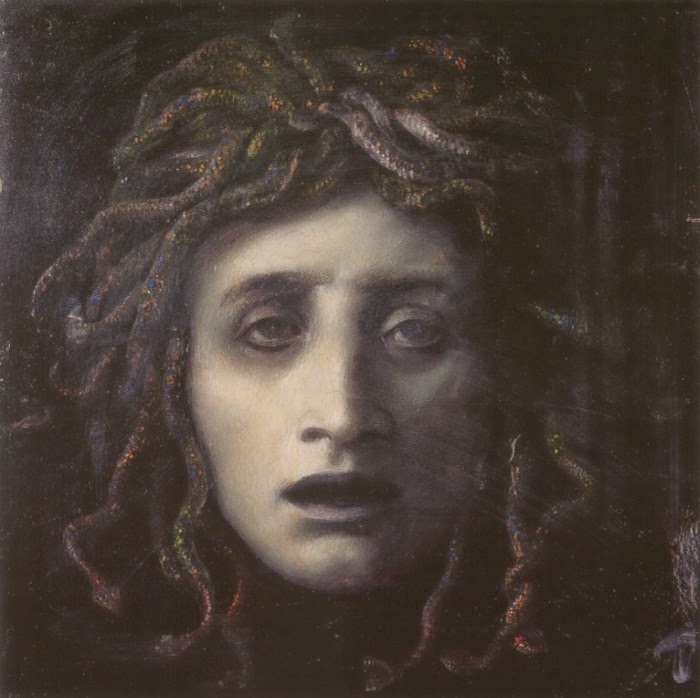
Sting wraps up with another mythological reference concerning turning his erstwhile master's face to alabaster. This could be a nod to Medusa, or not. At the end of the day, you can take the song as just a catchy melody, or a paean to overcoming that which has control over your existence. But you will never get that from the video unless breaking free from a cage of candlesticks is your cup of tea.

Homer's illustration seems to show that, in life, there are no clear moral choices. In effect, the end justifies the means. Charybdis destroys the ship and kills the entire crew, but Odysseus is saved. He is forced to live in physical relationship with Calypso despite the fact that his overriding purpose is to return home to his wife Penelope. I can see how that would go over today..."Sorry honey, but that thing with Calypso...the gods made me do it; I didn't love her."

Yet what choices do we have today? Are our lives so different from the mythic struggles of Odysseus? Would modern society forgive the loss of a ship's crew and years of adultery as long as our motives were pure? That is a question that appears to bedevil us. In my opinion the struggle comes because, for the six billion-plus inhabitants of planet Earth, there is no one standard, no single moral compass to which we can all look.

Or is there?

One thing that myth and religion have in common is the recognition that there are things which happen that are bigger than we are. Whether you believe in the God of the Bible or not, there is no way you can ascribe history to a random mixture of human strength and blind luck. It is the interpretation of cause - the source of the supernatural - about which we argue. Followers of Christ do not see evil on both sides of life. Ours is not a struggle against Scylla and Charybdis. Others who deny the deity of Jesus see the battle as between humanism and religion; one side insanity, and the other reason. While modern life is not truly a choice between Scylla and Charybdis, we still face epic battles of moral import.

In which direction will you sail?

X